
Transparency matters to us. If you’re going to use a numerology tool to understand yourself better, you should know exactly how that tool arrives at its conclusions. This page documents the complete methodology behind every calculator on Lo Shu Grid Calculators — from how we extract numbers from your date of birth, to how we assign meanings to planes and combinations, to how we derive the remedies we recommend.
We have written this for a general reader. You don’t need a background in numerology to follow it. We believe that a system worth trusting is one you can examine.
The Foundation — What the Lo Shu Grid Is
The Lo Shu Grid is a 3×3 magic square with a documented history stretching back approximately 4,000 years to ancient China. Its origin legend describes King Yu of the Hsia Dynasty observing a tortoise emerging from the Lo River, its shell bearing a pattern of dots arranged in a grid where every row, column, and diagonal summed to 15. This pattern became the basis for the Lo Shu square — the world’s earliest recorded magic square.
In the numerological tradition that developed from this, the grid is used not as a mathematical puzzle but as a mapping tool: the digits of a person’s birth date are plotted onto the nine positions of the square, and the resulting pattern of present, absent, and repeated numbers is interpreted to reveal personality strengths, energy imbalances, and life tendencies.
The fixed arrangement of the Lo Shu Grid is:
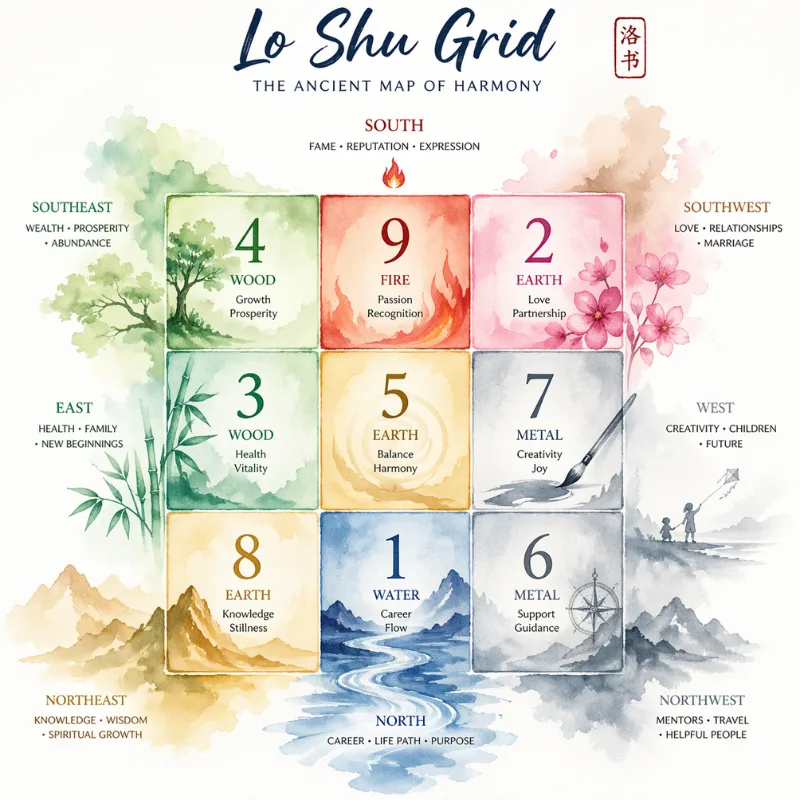
Each number occupies a permanent position. Numbers are never moved. The sum of every row, column, and diagonal is 15. This mathematical property — not mysticism — is what gives the grid its structural integrity.
Step-by-Step Calculation Process
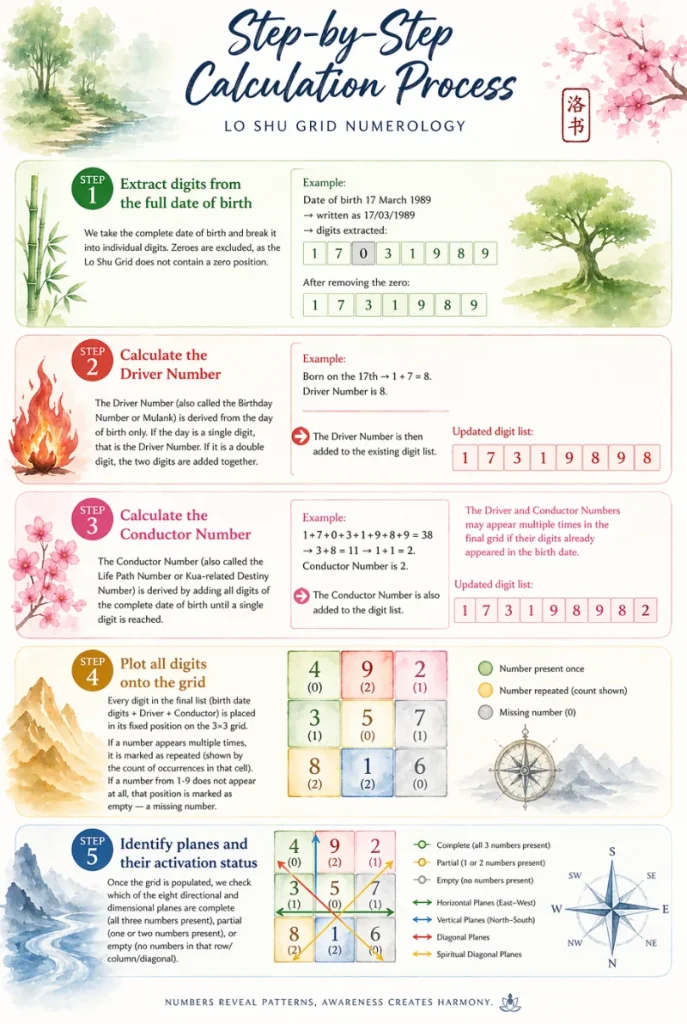
Step 1: Date of Birth Synchronization
The Lo Shu Grid is entirely dependent on your birth date. Our system begins by stripping away the zeroes (as 0 is considered a placeholder for infinite potential but does not occupy a specific house in the 3×3 grid).
- Full Date Analysis: We extract the Day, Month, and Year.
- Number Extraction: Each digit (1–9) is treated as an individual energy carrier.
Step 2: The 3×3 Magic Square Population
Our calculator uses the traditional fixed-position layout. Unlike other numerology systems where numbers move, the Lo Shu houses are permanent.
The Fixed Alignment:
- Top Row: 4 (Wood), 9 (Fire), 2 (Earth)
- Middle Row: 3 (Wood), 5 (Earth), 7 (Metal)
- Bottom Row: 8 (Earth), 1 (Water), 6 (Metal)
If your birth date is 17th March 1989 (17/03/1989), our system extracts the digits 1, 7, 0, 3, 1, 9, 8, 9, and then populates the grid with 1, 7, 3, 1, 9, 8, 9. Notice how the 0 is omitted, and repeated numbers are stacked within the same house.
Step 3: Calculating the Driver and Conductor
To provide a comprehensive analysis, we calculate two additional power numbers that are often missed by basic tools:
- The Driver (Psychic Number): Derived from your birth day. It represents your basic personality.
- The Conductor (Destiny Number): The sum total of your entire birth date reduced to a single digit. This represents your life’s purpose.
These two numbers are then added to your grid, often filling gaps that the birth date alone leaves behind.
Example: For date of birth 17/03/1989 —
- Born on the 17th → 1 + 7 = 8. Driver Number is 8.
- 1+7+0+3+1+9+8+9 = 38 → 3+8 = 11 → 1+1 = 2. Conductor Number is 2.
Step 4: Analyzing the Eight Planes
Once the grid is full, our algorithm scans for vertical, horizontal, and diagonal alignments. In Lo Shu tradition, a full row of three numbers creates a plane.
Our system analyzes three groups of planes:
- Mind, Emotional, and Practical Planes (Horizontal): How you process thoughts, feelings, and actions.
- Planning, Willpower, and Success Planes (Vertical): How you organise, sustain effort, and convert opportunity into results.
- Golden Yog and Silver Yog (Diagonal): The two rarer combinations that signify high-level prosperity and stability.
Step 5: The Kua Number Integration
Unique to our methodology is the integration of the Kua Number from Chinese Feng Shui (Ba Zhai / Eight Mansions), as adopted in Indian numerology practice. It identifies your favourable directions for sleeping, working, and important activities.
How it is calculated. Take the last two digits of your birth year and reduce them to a single digit — call it S.
- Born before 2000: Male: 10 − S · Female: 5 + S (reduce to a single digit) Example — born 1984: 8 + 4 = 12 → 3. Male: 10 − 3 = 7. Female: 5 + 3 = 8.
- Born 2000 or later: Male: 9 − S (if the result is 0, the Kua is 9) · Female: 6 + S (reduce to a single digit) Example — born 2005: 0 + 5 = 5. Male: 9 − 5 = 4. Female: 6 + 5 = 11 → 2.
The Kua 5 rule. Kua 5 has no trigram of its own in the Eight Mansions system, so it is never assigned: males who compute to 5 take Kua 2, and females take Kua 8. This substitution is the classical standard.
The solar-year rule. The Chinese solar year begins around 4 February, not 1 January. Births from 1 January to 3 February therefore use the previous calendar year for the Kua calculation. Our calculator applies this automatically.
In July 2026 we corrected our post-2000 and female Kua calculations to align with the classical tables, and this page was updated to match.
Step 6: Remedial Logic & Element Balancing
The final step is identifying missing numbers. If a house is empty, our system cross-references the missing element (e.g., Wood, Metal) with a database of traditional and practical remedies.
- Tradition Guardian Verification: Every remedy is reviewed by our expert to ensure it aligns with classical Chinese Five Element theory.
- Digital Accuracy: Our algorithms ensure that no clashing remedies (like adding Fire to a Metal-dominated grid) are ever recommended.
Our Context-Based Calculators
In addition to the core grid, our platform offers specialized calculators for:
- Marriage compatibility
- Career insights
- Government Jobs
- Financial tendencies
- Mobile number analysis
- Childbirth-related numerology
Each tool applies the same core methodology, but adapts interpretation logic to the specific context.
The Eight Planes — How We Interpret Them
The Lo Shu Grid has three horizontal planes, three vertical planes, and two diagonal planes. Each represents a different dimension of personality and capacity.
| Mind Plane (4-9-2) | Horizontal — top row. Governs intellect, analytical ability, memory, and concentration. A complete Mind Plane indicates strong thinking capacity. An empty Mind Plane does not indicate low intelligence; it suggests the person thinks more intuitively than analytically. |
| Emotional Plane (3-5-7) | Horizontal — middle row. Governs feelings, emotional expression, spiritual inclination, and intuition. The middle row is unique because it contains 5 — the centre of the grid and the most significant position. |
| Practical Plane (8-1-6) | Horizontal — bottom row. Governs practical ability, physical work, execution, and material engagement. A complete Practical Plane is associated with good organisational capacity and financial reliability. |
| Planning Plane (4-3-8) | Vertical — left column. Governs the process of idea generation and how thoughts translate to plans. Associated with creativity and strategic thinking. |
| Willpower Plane (9-5-1) | Vertical — centre column. Governs determination, willpower, and goal-directed behaviour. The most significant vertical plane because it contains 5. |
| Success Plane (2-7-6) | Vertical — right column. Governs the ability to follow through on decisions, take practical steps, and maintain commitments. |
| Golden Yog (4-5-6) | Diagonal — top-left to bottom-right. When all three numbers are present, this rare formation (found in roughly 2–3% of birth dates) is traditionally associated with leadership, name, and material success. | |
| Silver Yog (2-5-8) | Diagonal — top-right to bottom-left. Associated with property, asset accumulation, and long-term wealth management. More common than the Golden Yog and a primary indicator in our money calculator. | |
Individual Number Meanings
Each of the nine numbers in the grid carries a set of associated qualities. Our interpretations are drawn from the established tradition of Lo Shu numerology as documented in practitioner literature, cross-referenced across multiple sources by Aravind Krishnan during fourteen years of study. We list the primary associations below:
| Number 1 | Career, communication, independence. Planetary ruler: Sun. Element: Water (in the Lo Shu tradition). Direction: North. Associated with leadership and verbal expression. |
| Number 2 | Emotion, relationships, sensitivity. Planetary ruler: Moon. Element: Earth. Direction: Southwest. People with strong 2 energy are empathetic, intuitive, and attuned to others. |
| Number 3 | Memory, creativity, planning. Planetary ruler: Jupiter. Element: Wood. Direction: East. Strong 3 energy correlates with strong recall and imaginative thinking. |
| Number 4 | Stability, practicality, wealth foundation. Planetary ruler: Rahu. Element: Wood. Direction: Southeast. Contrary to common superstition in Western contexts, 4 is a positive number in this system. |
| Number 5 | Balance, freedom, adaptability. At the grid’s centre, 5 is the most influential position. Its presence or absence significantly affects the reading of adjacent numbers and planes. Element: Earth. No fixed direction — it governs the centre. |
| Number 6 | Responsibility, home, luxury, financial security. Planetary ruler: Venus. Element: Metal. Direction: Northwest. Associated with domestic harmony and a taste for comfort. |
| Number 7 | Spirituality, trust, inner wisdom. Planetary ruler: Ketu. Element: Metal. Direction: West. Governs self-awareness, introspection, and belief systems. |
| Number 8 | Material success, wealth, authority. Planetary ruler: Saturn. Element: Earth. Direction: Northeast. The most wealth-associated number in the grid; its presence or repetition amplifies financial potential. |
| Number 9 | Ambition, completion, wisdom. Planetary ruler: Mars. Element: Fire. Direction: South. The highest number — associated with leadership, humanitarian impulse, and the drive toward mastery. |
Missing Numbers — Our Interpretation Standard
A missing number is a number from 1–9 that does not appear anywhere in the final digit set (birth date digits + Driver + Conductor). It does not mean the qualities associated with that number are absent from the person. Rather, it means those qualities are less naturally activated and may require more conscious effort to develop.
Our calculators provide specific, practical remedies for missing numbers. These remedies come from the established tradition of Lo Shu Grid practice and are grounded in the elemental associations of each number. They are not invented by us. These remedies are our curated, plain-language presentation of practices that numerology practitioners have documented and recommended for decades.
We are careful not to overstate the significance of missing numbers. The Lo Shu Grid is a tool for self-understanding, not a diagnostic system. A person with missing number 8 is not doomed to financial difficulty. A person with missing number 2 is not incapable of loving relationships. These are tendencies and patterns, not fates.
Special Combinations — The Two Yogs
Golden Yog (4-5-6)
The Golden Yog, also called Golden Rajyog, occurs when all three numbers 4, 5, and 6 are present in a person’s grid. This diagonal combination is found in an estimated 2–3% of birth dates. It is traditionally associated with name, fame, and material success. We verify this combination is fully present before flagging it in results — partial presence (e.g., only two of the three numbers) is not considered a Golden Yog.
Silver Yog (2-5-8)
The Silver Yog (2-5-8) runs diagonally (top-right to bottom-left) and is associated with asset accumulation, financial stability, and wealth management capacity. It is more common than the Golden Yog. In our money calculator, the Silver Yog is a primary indicator of strong financial potential.
Arrow of Frustration
An Arrow of Frustration refers to a diagonal or line where all three positions are empty — a complete absence of three connected numbers. These patterns are interpreted as areas of significant challenge, since the entire line carries no activated energy at all. We identify these automatically in calculator results and explain their significance in plain terms.
What Our Calculators Do Not Do
We consider it important to be clear about limitations as well as to explain capabilities.
- Our calculators do not predict specific events. Numerology identifies tendencies and energy patterns, but not outcomes.
- We do not use AI to generate interpretations. Every meaning statement in our results is authored by Aravind Krishnan and is the same for every person whose grid shows that pattern.
- We do not factor in time of birth, name, or geographical location into the core Lo Shu Grid calculation. Some numerological traditions include these variables — we follow the pure date-of-birth methodology, which is the most widely practised standard for Lo Shu Grid analysis.
- Our name field (where offered) is used for personalised output display only — not for any calculation.
- We do not claim scientific validity for numerology. It is a traditional knowledge system, not an evidence-based science. We present it honestly as such.
How We Handle Edge Cases
Certain birth dates create calculation edge cases that simpler calculators handle poorly. We document our handling below:
- Dates with multiple zeroes (e.g., 10/10/2000): All zeroes are excluded from the grid. The grid is populated from non-zero digits only, plus the Driver and Conductor.
- Single-digit birth days (e.g., born on the 5th): The Driver Number is 5. It is added once to the digit list. No double-counting.
- Master numbers in Conductor calculation: We do not treat 11, 22, or 33 as master numbers in the Lo Shu Grid tradition. All Conductor Numbers are reduced to a single digit. This is standard practice in Lo Shu Grid numerology (as distinct from Pythagorean numerology, where master numbers are often retained).
- Repeating birth year digits (e.g., 1999): Both 9s are counted individually. A person born in 1999 will have three instances of 9 from their birth year alone — this is significant in plane analysis and is correctly handled by our calculator.
Why Our Methodology Matters
Most online tools for Lo Shu Grid calculation use thin logic — a generic description with little underlying structure. We use layered logic instead. By combining the birth date, Driver/Conductor numbers, and the Kua number, we provide a multi-dimensional map that is unique to you.
Data Integrity Note: We process calculations locally in your browser session. Your personal birth data is never stored on our servers, ensuring your privacy throughout.
Continuous Refinement
Our methodology is not static; we regularly improve it based on:
- Edge case testing (unusual date patterns)
- Output consistency checks
- User feedback
- Ongoing study of numerology systems
Every update is reviewed before being applied to live calculators.
Transparency and Responsibility
We believe users should understand how their results are generated. That is why:
- Our calculation logic follows standard Lo Shu Grid principles
- Our interpretations are clearly structured
- Our limitations are openly stated
Lo Shu Grid analysis is intended for guidance and self-reflection. It should not be considered as professional, financial, medical, or legal advice. Users are encouraged to apply their own judgment when interpreting results.
Curious About Your Own Pattern?
See your complete Lo Shu Grid — every number, missing number, and active plane — generated instantly from your date of birth.
Calculate Your Lo Shu Grid Now →This methodology is reviewed and updated by Aravind Krishnan whenever practitioner literature evolves or user feedback reveals an inconsistency.