
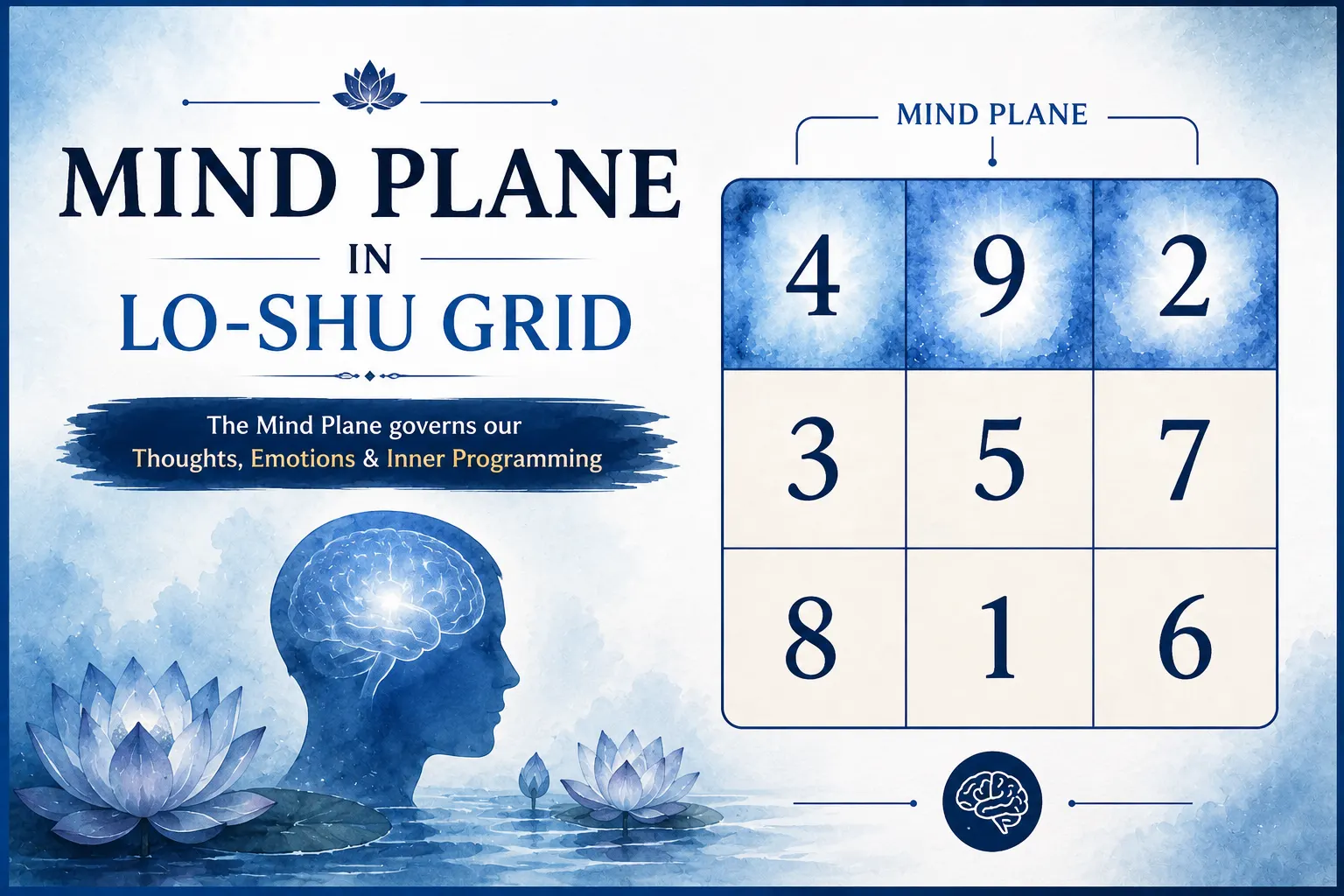
Mind Plane or Thought Plane in the Lo Shu grid is the top horizontal row formed by the numbers 4, 9, and 2. It governs thinking patterns, mental clarity, imagination, memory, decision-making, and emotional processing. This plane shows how a person analyses situations, plans actions, and responds mentally to the world around them.
A balanced Mind Plane creates clarity, stability, and strategic thinking. An imbalanced or missing Mind Plane often leads to overthinking, confusion, emotional reactions, impulsive decisions, or lack of direction. In simple terms, this plane acts as the mental control centre of the Lo Shu Grid.
What are the Numbers in the Mind Plane?
The numbers in the Mind Plane are 4, 9 and 2, as shown below in the image:
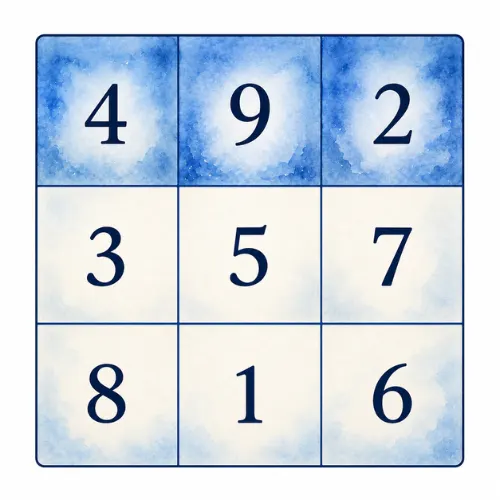
Each number in the 4-9-2 sequence contributes a different mental quality.
- Number 4 represents structure, discipline, logic, and organised thinking. It helps a person create systems, follow plans, and think practically. This number gives stability to the mind.
- Number 9 represents ambition, intensity, courage, and execution power. It creates mental strength, determination, and the ability to stay focused under pressure. This is the driving force behind action and achievement.
- Number 2 represents intuition, emotional intelligence, sensitivity, and perception. It allows a person to understand emotional dynamics, human behaviour, and subtle details that logic alone may miss.
When these three energies work together, they create a balanced mental framework where logic, action, and intuition support each other.
What does a Complete Mind Plane Mean?
A complete Mind Plane forms when all three numbers — 4, 9, and 2 — are present in the grid. People with this combination usually possess strong analytical ability, sharp memory, and clear thinking. They naturally process information in a structured manner and often think several steps ahead before taking action.
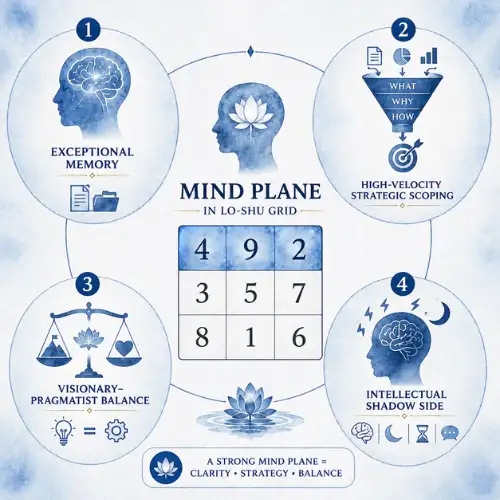
These individuals usually understand complex situations quickly. Their minds instinctively break problems into layers:
- What is the issue?
- Why did it happen?
- How can it be solved?
Because of this structured approach, they often perform well in leadership, planning, business strategy, finance, technology, management, and operations.
A strong Mind Plane also creates a balance between vision and practicality. These people are not just dreamers. They usually understand the systems, discipline, and effort required to turn ideas into reality. Number 4 provides planning, Number 9 drives execution, and Number 2 adds emotional awareness and adaptability.
Another important trait of a strong Mind Plane is mental stability during pressure. While others panic during conflict or crisis, these individuals often become calmer and more focused. They organise chaos quickly, identify the root problem, and create structured solutions.
However, a highly active Mind Plane also carries challenges. When mental energy becomes excessive — especially with repeated 4s or 9s — the person may become mentally restless, impatient, overly analytical, or emotionally detached. Overthinking, insomnia, perfectionism, and difficulty switching off the mind are common signs of an overstimulated Mind Plane.
What are the Traits of a Strong Mind Plane?
People with a strong Mind Plane usually think before they act. They rarely make major decisions impulsively and often evaluate situations from multiple angles before reaching conclusions.
In professional environments, they often become the people others rely on during uncertainty. They tend to remain composed in difficult meetings, operational crises, or strategic discussions because their minds naturally search for systems and solutions instead of reacting emotionally.
During arguments or conflicts, they usually rely on facts, timelines, logic, and patterns rather than emotional outbursts. They remember details clearly and often notice inconsistencies others overlook. Because of this, they can be extremely persuasive communicators and strong problem-solvers.
Their long-term thinking ability also stands out. They naturally evaluate consequences, future risks, and sustainability before taking action. This gives them an advantage in careers that require planning, structure, or strategic decision-making.
The Missing Mind Plane
When the numbers 4, 9, and 2 are partially or completely absent, the grid forms a Missing Mind Plane. A missing mind plane is not an indication of low intelligence. Instead, it shows that mental structure and sustained focus are not naturally anchored.
People with a weak Mind Plane often experience fluctuating concentration. They may have brilliant ideas and strong creativity, but struggle to maintain focus or consistency for long periods. Their minds drift quickly toward immediate action, emotional reactions, or distractions.
This often creates patterns such as:
- Starting projects enthusiastically but not finishing them
- Making decisions emotionally or impulsively
- Feeling mentally scattered or overwhelmed
- Struggling with long-term planning
- Experiencing decision fatigue during important life choices
Without a strong mental filter, too much information or too many options can quickly create confusion.
Many people with a missing Mind Plane also rely heavily on emotions or immediate physical action. Instead of planning carefully, they may jump directly into execution and learn through mistakes and experience. This can create unnecessary delays, repeated errors, or unstable decision-making.
At the same time, a missing Mind Plane also has positive aspects. These individuals are often flexible, adaptable, action-oriented, and emotionally expressive. Unlike people with excessive mental energy, they may take risks more easily and avoid getting trapped in over-analysis.
The key challenge is learning how to create external structure for a mind that lacks natural internal organisation.
What are the Remedies to Balance the Mind Plane?
The Mind Plane becomes stronger through discipline, mental order, and emotional control. The goal is not to think more, but to think more clearly.
- One of the most effective remedies is developing the habit of planning before action. People with a weak Mind Plane often rush into decisions without creating a proper roadmap. Writing goals, priorities, timelines, and action steps on paper helps organise scattered thoughts and strengthens mental discipline.
- Delaying major decisions also improves balance. Emotional reactions often weaken judgment. Creating a personal rule to wait before making important financial, relationship, or career decisions helps reduce impulsive thinking and improves clarity.
- The physical environment also affects the Mind Plane strongly. Cluttered spaces often increase distraction and mental instability. Keeping workspaces clean, organised, and visually calm improves concentration and focus significantly.
- Meditation, deep breathing, mantra chanting, journaling, and periods of silence can also stabilise mental energy. These practices help reduce overthinking and improve emotional control.
- Reducing information overload is equally important. Constant social media exposure, excessive multitasking, and continuous digital stimulation weaken concentration and increase mental fatigue. A calm and focused mind always processes information more effectively than an overloaded one.
- Ultimately, the true strength of the Mind Plane lies in balance. A powerful mind is not the one that thinks constantly, but the one that knows when to analyse, when to act, and when to remain calm under pressure.
Frequently Asked Questions
What is the Mind Plane in the Lo Shu Grid?
The Mind Plane is the top horizontal row of the Lo Shu Grid that governs your intellectual mass, cognitive processing, and strategic foresight. It acts as your internal operating system, dictating how you gather data, analyse patterns, and conceptualise your life blueprint before taking physical action.
Which numbers form the Mind Plane in Lo Shu numerology?
Numbers 4, 9, and 2 form the Mind Plane in Lo Shu numerology. Number 4 provides structural logic and discipline; Number 9 injects raw ambition and execution drive; Number 2 introduces intuition and emotional intelligence. Together, this sequence constructs your absolute cognitive axis.
What does a complete Mind Plane mean in the Lo Shu Grid?
A complete Mind Plane means you possess an active intellectual matrix characterised by exceptional memory retention, strategic scoping, and logical clarity. You instinctively process information through a structured “What → Why → How” hierarchy, allowing you to build grand visions backed by a mechanical comprehension of reality.
What happens if the Mind Plane is missing in Lo Shu numerology?
If the Mind plane is missing, it creates a permanent strategy gap, meaning you process life through immediate actions or emotional responses rather than long-term planning. This structural void leads to concentration leakage, decisional fatigue, and a persistent tendency to jump into complex ventures without mapping out a proper blueprint first.
Can the Mind Plane reveal overthinking tendencies?
Yes, the Mind Plane directly reveals overthinking tendencies when its core numbers repeat (x2, x3, or x4). This numerical replication causes the mental processor to run too hot, triggering chronic anxiety, insomnia, structural analysis paralysis, and a combative need to argue points to the death to prove intellectual dominance.
What is the difference between the Mind Plane and the Emotional Plane in Lo Shu?
The Mind Plane (4-9-2) governs logic, memory, and structural strategy, processing life through data and analysis. Conversely, the Emotional Plane (3-5-7) rules the heart axis, dictating how you process trust, empathy, and personal boundaries based purely on intuitive resonance and feeling.
What remedies are suggested for a weak Mind Plane in numerology?
To activate a weak Mind Plane, you must enforce a strict “blueprint-first” protocol by mapping projects on paper before execution. Implementing a mandatory 24-hour buffer phase before making major life choices stabilises decisional volatility, while placing a natural yellow jasper crystal on your desk grounds scattered mental energy.