
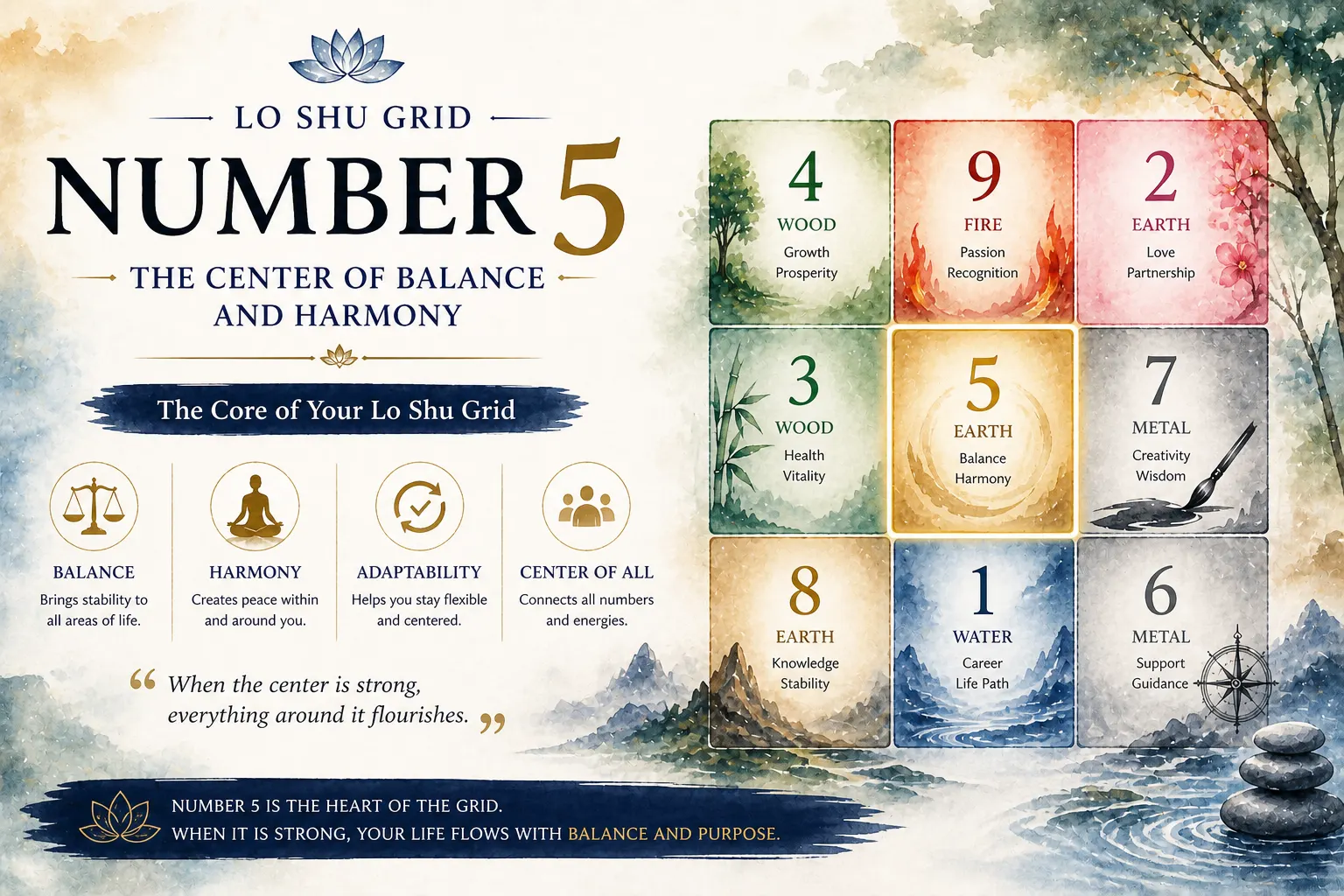
Number 5 holds the centre of the Lo Shu Grid, and conditions more of a chart than any other digit. This article covers what it governs, the traits associated with it, its career, relationship and health signature, what changes when it repeats, and what happens when the centre is empty.
What Does Number 5 Mean in the Lo Shu Grid?
Number 5 in the Lo Shu Grid is the Mercury position, governing balance, adaptability and the connection between every other part of the chart. It occupies the centre cell, carries the Earth element, holds no compass direction of its own, and sits on four of the grid’s eight lines — more than any other digit.
Where does Number 5 sit in the grid?
Number 5 occupies the exact centre, the only cell that touches no edge of the square:
| 4 | 9 | 2 |
| 3 | 5 | 7 |
| 8 | 1 | 6 |
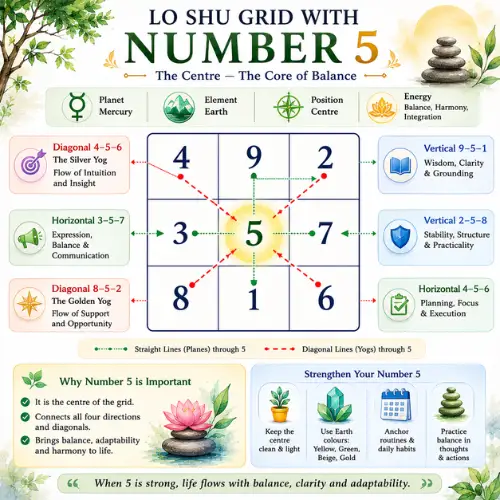
That position is not decorative. The digits 1 to 9 sum to 45, and 45 divided across three rows gives 15 — so every row, column and diagonal must total 15, and the centre must hold the arithmetic mean of the set. There is exactly one arrangement that satisfies this, and 5 sits at its middle by necessity rather than by choice.
Which lines does Number 5 form?
Four, which is the highest count in the grid. Corner numbers sit on three lines, edge numbers on two.
| Line | Numbers | What the 5 supplies |
|---|---|---|
| Emotional Plane | 3 · 5 · 7 | The bridge between expression (3) and analysis (7) |
| Willpower Plane | 9 · 5 · 1 | The bridge between ambition (9) and identity (1) |
| Golden Yog | 4 · 5 · 6 | The centre of the recognition diagonal |
| Silver Yog | 2 · 5 · 8 | The centre of the wealth diagonal |
Both diagonals pass through this cell, which has a consequence no other number carries: a missing 5 closes both Yogs simultaneously. See the eight lines of the Lo Shu Grid.
What Are the Personality Traits of Number 5 People?
Five traits are consistently associated with a strong Number 5:
- Systemic adaptability. They take the shape of whatever structure is built around them, which reads as flexibility from outside and as load-bearing from inside.
- The connective thread. They hold the small details about everyone in their circle — anniversaries, who is going through what — which is less sentiment than infrastructure for keeping a network from fraying.
- Freedom through stability. They travel, and they always have a return ticket and someone to call. Movement is comfortable; being stranded is not.
- Balanced decision-making. Sitting between every extreme, they are rarely the most extreme voice in a room, and they weigh opposing positions before committing to either.
- Inherent reliability. A broken promise registers as a structural failure rather than a social one, which is why a 5 tends to over-deliver rather than renegotiate.
A single 5 is a complete pivot. It does not need to repeat to do its job.
What is the shadow side of Number 5?
The centre position that makes Number 5 stabilising creates three specific costs.
- Decision paralysis disguised as balance. Weighing every side before acting tips into chronic indecision when stakes are high. The centre does not want to tip the scale in any direction, even when a decision is overdue.
- Invisible labour. A strong 5 is frequently the most load-bearing person in a room without the title that reflects it, which builds a quiet resentment that is hard to name because nothing visibly went wrong.
- Difficulty asking for support. The Earth pivot is built to support, not to be supported. Under real strain a 5 often has no working template for receiving help, since being the stable point is their entire role in any system.
What Does Number 5 Mean for Career?
Number 5 sits where the Emotional Plane and the Willpower Plane cross, which in working life means it connects thought to action and ambition to identity. The practical consequence is that a strong 5 leads from the middle of an organisation rather than the front or the top — the role everything routes through.
Four directions suit a strong 5:
- Operations and project management — translating between departments that do not naturally speak to each other.
- Real estate and construction — the most literal expression of the Earth element, working in foundations.
- Adaptive entrepreneurship — ventures needing constant recalibration, where a wide field of view matters more than a fixed plan.
- Mediation and conflict resolution — equidistant from every edge of the square, a 5 has a structural neutrality that is hard to fake.
A 5 in a mid-level role is often the most influential person in the office regardless of title, and the traditional advice follows from the position rather than from ambition: become the point the room organises around instead of the loudest voice in it.
What Does Number 5 Mean for Relationships?
Number 5 is the only digit that does not occupy a perimeter cell, and in a relationship that reads as a partner who does not escalate — no gravitational pull toward either smothering or distancing. The steadiness is the defining feature.
Because the 5 sits where the Emotional and Willpower Planes cross, these people often become the unofficial counsellor in a partnership without having chosen the role. They can absorb an outburst and process it through something closer to logic than sympathy, which some partners find grounding and others find cold.
There is a limit. Earth needs a neutral zone to stay stable, and a relationship that runs permanently at high drama will eventually crack a 5’s footing. When it does they rarely fight for it — they quietly look for a new centre, because staying ungrounded is not something this position sustains.
What Does Number 5 Mean for Health?
Traditional Lo Shu associations link Number 5 to digestion and the stomach, the body’s own metabolic centre. The traditional reading is that when a 5-heavy chart’s life feels stable, digestion follows, and when it does not, that instability surfaces physically — commonly as acidity, bloating or low afternoon energy.
Three practices are traditionally suggested: time in physical contact with the ground, barefoot on soil or sand; higher hydration, since Earth needs water to stay workable rather than rigid; and core-focused movement engaging the mid-section.
This is traditional association, not diagnosis. Persistent digestive trouble belongs with a doctor rather than a chart, and no reading here should delay seeking medical advice.
What Happens When Number 5 Repeats in Your Grid?
Double 5 (55)
Two 5s create a centre wide enough that almost nothing tips it. These are often the people an extended family quietly defers to on large decisions — not because they asked for the role, but because their judgement has held up often enough that nobody questions it any more.
Triple 5 (555)
Three 5s produce a paradox. Too much stability starts to register as weight rather than foundation, and the usual response is a compulsive need for change — a new job, a new city, a hobby taken up and dropped. It is not restlessness for its own sake; it is pressure finding an exit.
Four or more 5s (5555+)
Four or more concentrate the centre so heavily that the person stops adjusting to the world and expects the world to adjust to them. The traditional reading is of someone admired for consistency and quietly exhausting to stay close to — the immovable object of the numerological world.
The traditional guidance for triple and quadruple 5s runs against the usual instinct: rather than seeking more stability, use the excess mass deliberately by helping other people steady their own situations. The reasoning is that a centre with no outlet becomes a cage.
Which Famous People Have Strong Number 5 Energy?
Public birth dates only, with no special insight into any of these three people — just the structural pattern their date produces. The arithmetic is shown so you can check it.
- Aamir Khan (14 March 1965) — digits 1, 4, 3, 1, 9, 6, 5. Driver: 1+4 = 5. Destiny: 29 → 2. Two 5s in total, one from the year and one from the Driver — a Double 5. The reinforced-centre pattern fits a public reputation for redoing scenes until they are structurally right.
- Mark Zuckerberg (14 May 1984) — digits 1, 4, 5, 1, 9, 8, 4. Driver: 1+4 = 5. Destiny: 32 → 5. Three 5s — month, Driver and Destiny all landing on the same digit. A Triple 5, which by the pattern above tends toward reinvention once an existing structure starts to feel like weight.
- Cristiano Ronaldo (5 February 1985) — digits 5, 2, 1, 9, 8, 5. Driver: 5. Destiny: 30 → 3. Three 5s again — the day, the year and the Driver. Longevity at his level tracks with a centre that does not wear down under repetition.
How Number 5 Connects to the Rest of Your Grid
The two planes it bridges. On the Emotional Plane (3-5-7) the 5 joins expression to analysis; on the Willpower Plane (9-5-1) it joins ambition to identity. A chart with 3 and 7 present but no 5 is the classic split — feeling and logic both available, alternating rather than combining.
Both Yogs. Number 5 is the shared cell of the Golden Yog in the grid and the Silver Yog in the grid. No other digit belongs to two rare formations at once.
When the centre is empty. A missing 5 leaves four lines a tier weaker and closes both diagonals — no other absence affects as much of the chart. The full pattern, its effects and the traditional remedies are covered in missing Number 5 in the grid.
Sibling profiles. Read Number 4 in the Lo Shu Grid and Number 6 in the Lo Shu Grid for the other two cells of the Golden Yog. All nine are indexed in the Lo Shu Grid numbers guide.
To see how many 5s your own chart carries and which of the four lines they complete, run your date through the Lo Shu Grid calculator.
Frequently Asked Questions About Number 5
What does Number 5 represent in the Lo Shu Grid?
Number 5 represents Mercury — balance, adaptability and the connection between every other part of the chart. It holds the centre cell, carries the Earth element, and forms part of four lines: the Emotional Plane, the Willpower Plane, the Golden Yog and the Silver Yog.
Why is Number 5 the most important number in the grid?
Because it sits on four of the eight lines, more than any other digit, including both diagonals. Structurally its presence or absence affects more of a chart than any other single cell.
Is having multiple 5s in your grid lucky?
Not automatically. A double 5 reinforces stability usefully. Three or more create a centre dense enough to feel like a constraint, which traditionally produces a restless drive for change rather than greater steadiness.
Which planet rules Number 5?
Mercury rules Number 5, paired with the Earth element and the centre position. Unlike the other eight numbers it holds no compass direction, because the centre of a square has none.
What career suits a strong Number 5?
Roles that function as a coordinating hub — operations, project management, real estate, and mediation. A strong 5 tends to be most effective leading from the centre of an organisation rather than from the top or the front.