
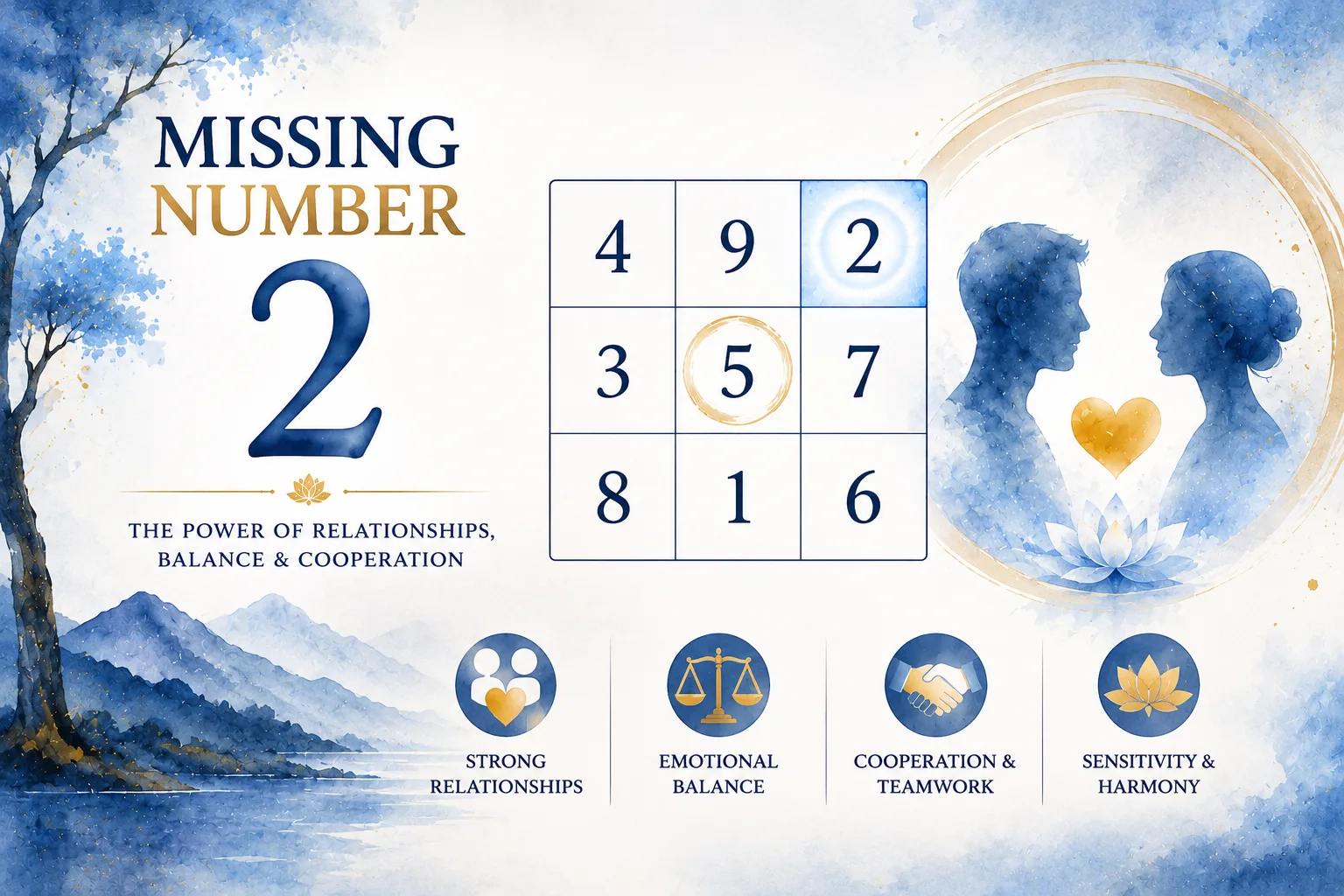
Number 2 is the Moon position in the Lo Shu Grid. This article covers what it governs, its traits, its relationship and career signature, what changes when it repeats, and how it connects to the rest of your chart.
What Does Number 2 Mean in the Lo Shu Grid?
Number 2 in the Lo Shu Grid is the Moon position, governing emotional intelligence, relationships and intuitive reading of other people. It occupies the top-right cell, carries the Earth element and the Southwest direction, and sits on three of the grid’s eight lines.
Where does Number 2 sit in the grid?
Number 2 occupies the top-right cell:
| 4 | 9 | 2 |
| 3 | 5 | 7 |
| 8 | 1 | 6 |
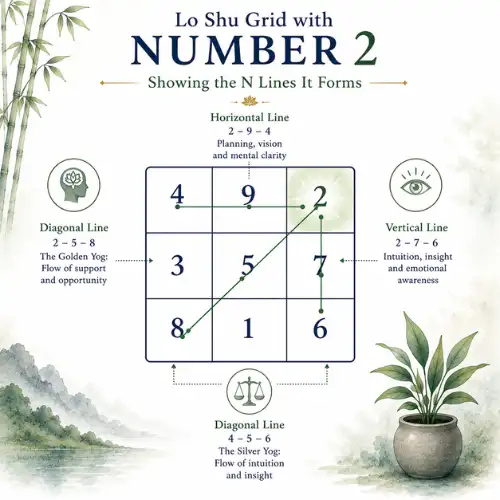
That corner placement puts Number 2 on three lines: the Mind Plane (4-9-2) across the top row, the Success Plane (2-7-6) down the right column, and the Silver Yog (2-5-8) on the falling diagonal. Three lines is above average — only Number 5 sits on more — which is why a missing 2 is felt across thinking, achievement and wealth simultaneously rather than in one domain.
What Are the Personality Traits of Number 2 People?
Five traits are consistently associated with a strong Number 2:
- Accurate reading of other people. A strong 2 registers mood and unstated tension quickly, often before the other person has named it.
- Preference for cooperation. Shared decisions feel safer and better than unilateral ones, which makes a 2 an effective partner and an uncomfortable sole authority.
- Conflict avoidance. The same sensitivity that reads a room accurately also makes confrontation costly, so disagreements get deferred.
- Diplomatic expression. Positions arrive softened. What a 1 states plainly, a 2 frames.
- Emotional absorption. A strong 2 takes on the emotional state of the people around them, which is the trait’s main long-term cost.
What Does Number 2 Mean for Relationships?
Number 2 is the grid’s primary relationship indicator, because the Moon position governs both emotional attunement and the instinct to maintain connection. A partner with a strong 2 notices shifts early, responds to unspoken needs, and treats the relationship’s stability as their responsibility to manage.
That strength carries two recognisable costs. The first is asymmetry: a strong 2 paired with a partner who has no 2 anywhere often ends up doing all of the relationship’s emotional maintenance without either person naming the arrangement. The second is accumulated avoidance — small unraised issues compounding, because raising each one individually felt disproportionate at the time.
Compatibility readings weigh this directly. Both partners’ full grids are compared in the marriage compatibility calculator, which scores Destiny harmony alongside shared and complementary gaps.
What Does Number 2 Mean for Career?
Number 2 suits work where reading people accurately is the core skill rather than a supporting one. Four directions fit a strong 2: counselling and therapeutic work, teaching and mentoring, human resources and mediation, and client-relationship roles where retention depends on trust rather than transaction volume.
Because the 2 also sits on the Success Plane (2-7-6), a strong 2 with a complete right column converts relational skill into professional advancement — the traditional reading of that line is achievement through networks rather than through solo effort.
What Happens When Number 2 Repeats in Your Grid?
Double 2 (22)
Two 2s deepen intuition to the point where it functions as a primary decision input. The traditional reading pairs this with a need for firmer emotional boundaries, since the same sensitivity that reads others accurately also absorbs their states more completely.
Triple 2 (222)
Three 2s produce overwhelming empathy. Practitioners associate this configuration with people who take on others’ distress as their own and progressively lose track of where their own preferences sit — the identity cost of unmanaged sensitivity.
Four or more 2s (2222+)
Four or more make emotional regulation the person’s central life task. The energy is not diminished but requires structure — routine, boundaries, and deliberate time alone — to remain usable rather than exhausting.
How Number 2 Connects to the Rest of Your Grid
The Mind Plane (4-9-2). Along the top row, the 2 supplies intuition, the 9 supplies ambition and the 4 supplies method. A complete Mind Plane is the traditional signature of good judgement — instinct checked by structure.
The Success Plane (2-7-6). Down the right column, the 2 supplies connection, the 7 supplies analysis and the 6 supplies follow-through. This is the line that converts opportunity into result.
The Silver Yog (2-5-8). The falling diagonal is the grid’s wealth-accumulation line, and the 2 anchors its top corner. A 2 present with 5 and 8 completes one of the two rare diagonals — read the planes guide for both Yogs.
The absence of Number 2. See Missing Number 2 remedies for what changes when the Moon position is empty.
Run your own date through the Lo Shu Grid calculator to see how many 2s your chart carries and which of the three lines they complete.
Frequently Asked Questions About Number 2
What does Number 2 represent in the Lo Shu Grid?
Number 2 represents the Moon — emotional intelligence, relationships and intuition. It occupies the top-right cell with the Earth element and Southwest direction, and forms part of three lines: the Mind Plane (4-9-2), the Success Plane (2-7-6) and the Silver Yog (2-5-8).
Is Number 2 good for marriage?
Yes, in the sense that a strong Number 2 supplies the emotional attunement most partnerships depend on. The qualification is balance: if only one partner carries a strong 2, that partner tends to absorb all of the relationship’s emotional maintenance, which is why compatibility is read across both complete grids rather than from one number.
Which planet rules Number 2?
The Moon rules Number 2, paired with the Earth element and the Southwest direction. The lunar association explains the number’s core themes — receptivity, cycles of mood, and responsiveness to other people.
What does a double 2 mean?
A double 2 intensifies intuition until it becomes a primary decision-making input, and it raises the need for deliberate emotional boundaries. It is generally read as a strength that requires management rather than as a difficulty.