
Published by Lo Shu Grid Calculators · Method documented on our Methodology page · Published on 30th May 2025 · Last reviewed on 3rd November 2026
Enter your date of birth to generate your Lo Shu Grid — the 3×3 magic square from Chinese numerology in which every row, column and diagonal adds up to 15. Your result shows which numbers are present, repeated and missing, which of the eight lines are complete, and your Driver, Destiny and Kua numbers, each explained in the Indian Lo Shu tradition. Every calculation follows our published method, so you can check your own grid by hand.
Calculate your Lo Shu Grid
Date of birth is the only thing required. Name is optional and only affects the name-number section
Lo Shu Grid Calculator
Your Lo Shu Grid is built entirely from your date of birth. Each digit takes its fixed place in the 3×3 square, and the pattern shows your present, repeated and missing numbers, the eight lines, and your Driver, Destiny and Kua — read in the traditional Indian way.
What Is the Lo Shu Grid?
The Lo Shu Grid is a 3×3 magic square from Chinese numerology in which the numbers 1 to 9 hold permanently fixed positions and every row, column and diagonal sums to 15. Your date of birth is the only input: each digit is placed into its fixed cell, and the resulting pattern of filled, empty and repeated cells is your personal grid.
In Chinese tradition the arrangement comes from markings on a turtle’s shell, seen in the river Lo — which is where the name comes from. Indian numerology adopted the same square and reads it against a birth date.
What separates the Lo Shu Grid from other numerology systems is spatial logic. Numbers are not only calculated — they are positioned. A digit’s meaning depends on which cell it occupies, how many times it appears there, and which of the eight lines it helps complete. A number appearing three times carries a different signature from the same number appearing once.
What is the fixed layout of the grid?
The layout never changes, regardless of birth date. What changes from person to person is which of those cells get filled. Your birth date supplies the digits; the square just tells each digit where to sit. The nine cells sit in this arrangement:
| 4 | 9 | 2 |
| 3 | 5 | 7 |
| 8 | 1 | 6 |
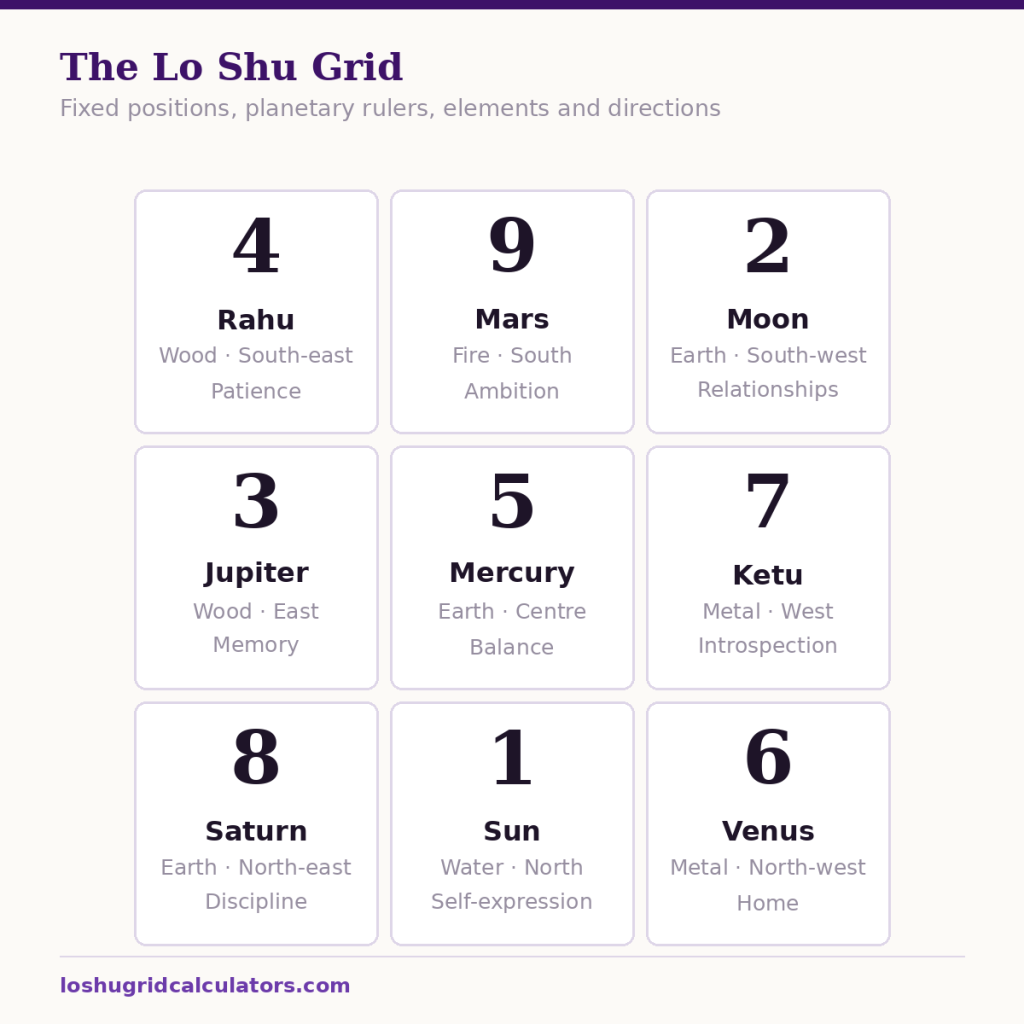
Every row sums to 15 (4+9+2), every column sums to 15 (4+3+8), and both diagonals sum to 15 (4+5+6 and 2+5+8). This property is what makes it a magic square and why the number 5 — the arithmetic mean of 15 divided across three cells — sits at the centre.
Which Numbers Go Into Your Grid?
Three sources, in this order:
- The digits of the date itself. Written in full, including the year. Zeros are dropped, because the grid has no zero cell.
- The Driver number — your birth day reduced to a single digit. Eg. Born on the 29th: 2+9 = 11 → 1+1 = 2.
- The Destiny number — every digit of the full date added together and reduced. Eg. 08/05/1984: 0+8+0+5+1+9+8+4 = 35 → 3+5 = 8.
Worked through on a real date. Take 11 March 1987. The digits are 1, 1, 0, 3, 1, 9, 8, 7 — the zero goes, leaving 1, 1, 3, 1, 9, 8, 7. Driver: the day is 11, so 1 + 1 = 2. Destiny: 1+1+0+3+1+9+8+7 = 30, then 3 + 0 = 3. So the grid holds three 1s, a 2, two 3s, a 7, an 8 and a 9 — and no 4, no 5, no 6.
Not every practitioner builds it this way. Some place only the date digits and leave the Driver and Destiny out of the square, which produces a different set of missing numbers from the same birthday. We include them, and we say so on the methodology page rather than leaving you to work out why two sites disagree about your chart. If you were taught the date-digits-only method, your grid will read differently here — that is a difference in method, not an error in either.
Three sets of digits enter your grid: every non-zero digit of your date of birth, your Driver number, and your Destiny number. Zeros are excluded
What Does Each Number Mean in the Lo Shu Grid?
Each number occupies one fixed cell and carries a planetary ruler, an element, a direction and a life domain. The nine profiles are summarised below; each also shows how many of the eight lines that number helps form, which is a direct measure of how much of your grid it influences.
| No. | Planet | Element | Direction | Governs | Lines it sits on |
|---|---|---|---|---|---|
| 1 | Sun | Water | North | Self-expression, career trajectory, initiative | 2 |
| 2 | Moon | Earth | Southwest | Emotional intelligence, relationships, intuition | 3 |
| 3 | Jupiter | Wood | East | Memory, structured communication, learning | 2 |
| 4 | Rahu | Wood | Southeast | Wealth, patience, long-game discipline | 3 |
| 5 | Mercury | Earth | Centre | Balance, adaptability, the hub of the grid | 4 |
| 6 | Venus | Metal | Northwest | Home, responsibility, comfort, financial discipline | 3 |
| 7 | Ketu | Metal | West | Introspection, analysis, spiritual trust | 2 |
| 8 | Saturn | Earth | Northeast | Discipline, method, material stability | 3 |
| 9 | Mars | Fire | South | Ambition, energy, recognition, completion | 2 |
The counts total 24, which is the eight lines multiplied by their three cells. Number 5 sits on four lines — more than any other digit — which is why its presence or absence changes the reading of the whole chart. Read the full profile in the Number 5 meaning guide, or start with Number 1 meaning. Every published profile is listed in the complete numbers guide.
What Are the Eight Lines of the Lo Shu Grid?
The Lo Shu Grid contains eight lines: three rows, three columns and two diagonals. Six are called planes and the two diagonals are called Yogs. A line is fully active when all three of its numbers are present in your grid, and the strength of each line is reported in tiers — Strong when three cells are filled, Moderate at two, Weak at one, Absent at none. Read all eight in the planes guide.
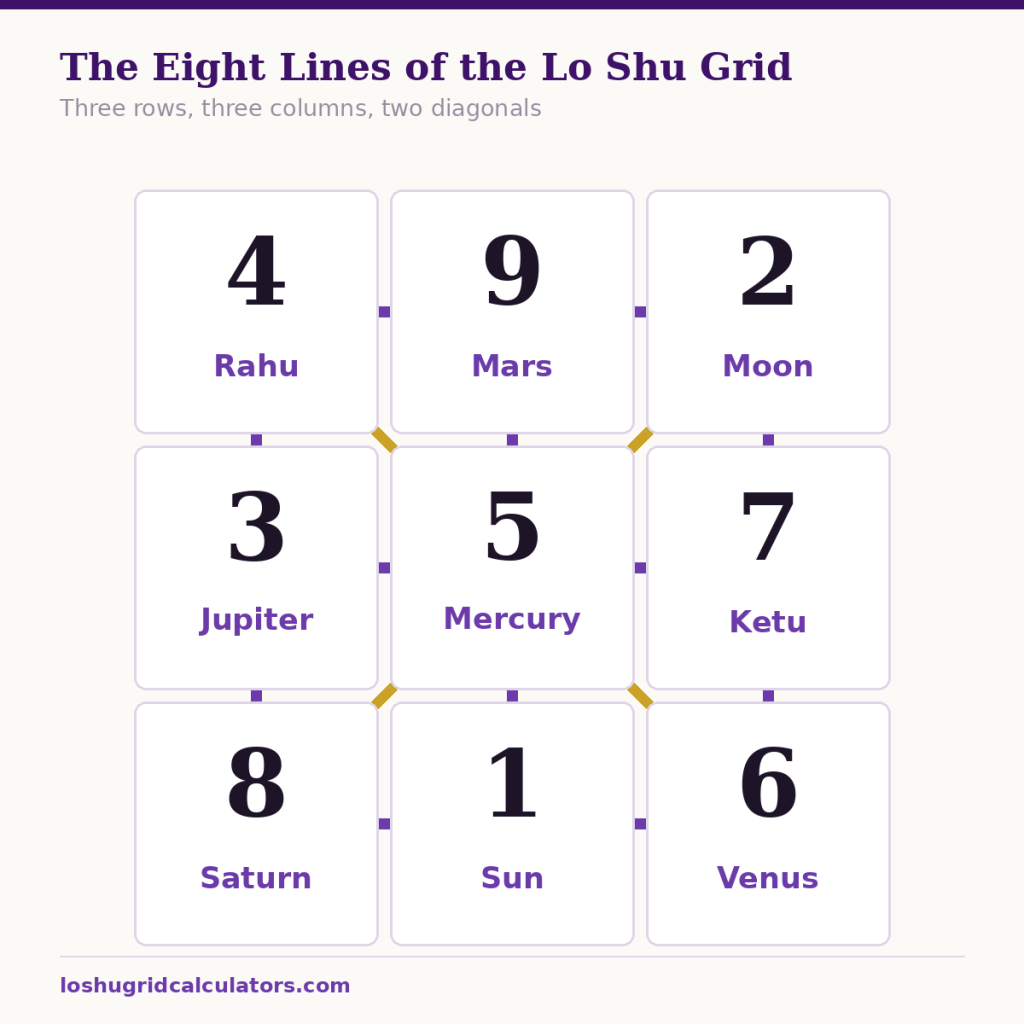
Eight lines run through the square: three rows, three columns and the two diagonals. A line is read as complete when all three of its cells hold at least one digit.
| Line | Numbers | Direction | What it governs |
|---|---|---|---|
| Mind Plane | 4 · 9 · 2 | Top row | Thinking, memory, imagination |
| Emotional Plane | 3 · 5 · 7 | Middle row | Feeling, art, relationships |
| Practical Plane | 8 · 1 · 6 | Bottom row | Doing, organising, material work |
| Thought Plane | 4 · 3 · 8 | Left column | Planning, ideas, how things begin |
| Will Plane | 9 · 5 · 1 | Centre column | Determination, self-belief |
| Action Plane | 2 · 7 · 6 | Right column | Follow-through, finishing what starts |
| Golden Yog (Raj Yog) | 4 · 5 · 6 | Diagonal ↘ | Name, recognition, material success |
| Silver Yog | 2 · 5 · 8 | Diagonal ↙ | Assets, property, long-term wealth management |
What is an Arrow of Frustration?
A line whose three cells are all empty. The tradition reads it as a weakness in that area rather than a missing piece — the difference being that an incomplete line is partly there, and an Arrow of Frustration is not there at all.
These are far less common than incomplete lines. Most charts have several lines missing one cell and no line missing all three.
What Do Missing Numbers Mean?
A missing number is a digit that appears nowhere — not in the date, not in the Driver, not in the Destiny. Its cell stays empty.
The tradition reads an empty cell as a quality that does not arrive on its own. Not an absence of it, and not a fate: something that takes deliberate effort where someone holding that number gets it for free. That distinction is the whole of the reading, and most sites blur it.
Which missing numbers appear most often?
We computed this across every calendar date from 1950 to 2010 — 22,280 dates — rather than repeating the figures that circulate in the niche:
| Missing number | Share of birth dates |
|---|---|
| 4 | 59.98% |
| 3 | 57.80% |
| 6 | 51.36% |
| 8 | 51.24% |
| 7 | 51.22% |
| 5 | 51.20% |
| 2 | 31.59% |
| 9 | 11.21% |
| 1 | 4.82% |
Then we checked it against 9,206 real birth dates people entered here, which came back different in one instructive way. Among real readers, missing 6 overtakes missing 4 — 59.37% against 57.68% — and missing 9 nearly doubles, from 11.21% to 19.92%.
The 9 has a plain explanation. Anyone born between 1900 and 1999 gets a 9 free in the century digits and can almost never be missing it. Readers born from 2000 onward get no such gift, and a quarter of the people using this calculator were born in the 2000s. The calendar figure averages a century; the reader figure describes who is actually here.
Two things follow. A missing 1 is genuinely rare — under 5% — and a missing 4 or 3 is close to a coin flip, which means most of the “rare and significant gap in your chart” writing in this niche is describing the majority of people. We would rather tell you that than sell you the opposite. The full working, both datasets, is in our frequency study.
Readings for each gap: missing numbers hub.
How Do You Read Your Own Grid Result?
Read your result in five steps, in this order — the sequence matters, because each layer conditions the next.
- Driver number — your instinctive operating energy, the way you approach decisions.
- Destiny number — your longer-term direction, calculated from the full date.
- Line strengths — which of the eight lines are Strong, Moderate, Weak or Absent.
- Missing numbers — the empty cells and their remedies.
- Repeated numbers — where one energy is amplified, and what that amplification costs.
Never read a single number in isolation. A missing 6 in a chart with a Strong Practical Plane reads very differently from a missing 6 in a chart where the Practical Plane is already Weak — the pattern is the meaning.
What Lo Shu Grid Predictions Can and Cannot Tell You
“Prediction” in Lo Shu reading does not mean forecasting events. It means reading the structure of a chart forward. The reading give information like which tendencies are already active, which qualities will need deliberate effort, and which periods of your personal year cycle amplify each one.
- What the grid can describe: recurring behavioural patterns, the qualities a missing number leaves undeveloped, which of the eight lines carry structural support, how a repeated number amplifies one energy at the cost of another, and the theme of the personal year you are currently in.
- What it cannot do: name a date, predict a specific event, diagnose a medical condition, guarantee a financial or marital outcome, or tell you what decision to make. A grid built from a birth date contains no information about anything that happened after that date.
A Lo Shu prediction is a description of terrain rather than a forecast of weather. It tells you which ground is firm and which needs building on, not what will happen when you walk across it.
Beyond the Basic Reading: Where the Grid Is Applied
Once your grid is generated, the same nine numbers are read through different domain lenses. Each has its own calculator, and each reads a different subset of your chart.
Relationships. Two grids compared against each other score differently from either grid read alone — Destiny harmony, shared blind spots, and the gaps one partner fills for the other. Run both dates through the marriage compatibility calculator.
Money. The wealth reading keys on numbers 8, 6, 5 and 1 plus the Silver Yog and Practical Plane — see the money calculator.
Numbers you choose. A birth date is fixed, but a mobile number is not. Alignment for mobile, vehicle and account numbers is keyed to your Destiny number — the mobile number calculator checks a number against your chart.
How the calculations are derived. The formulas for Driver, Destiny and Kua, the solar-year rule, and the sources behind each interpretation are documented in full on the calculation methodology page.
Lo Shu Grid Paid Report: How does it looks like?
Nobody should pay for a document they have not seen. So here is one.
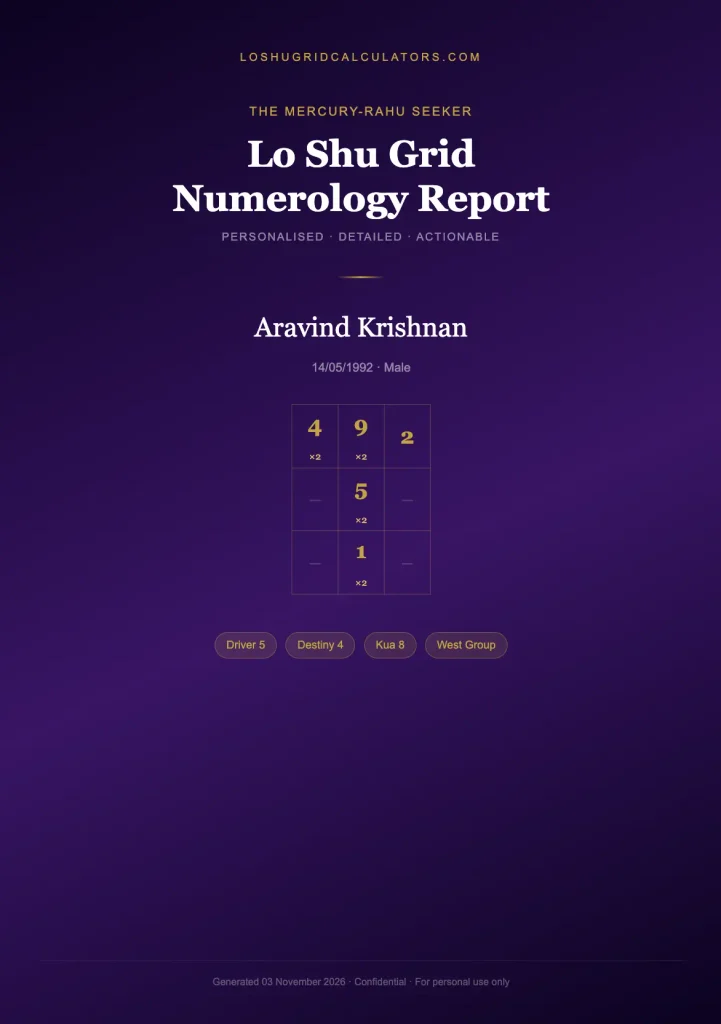
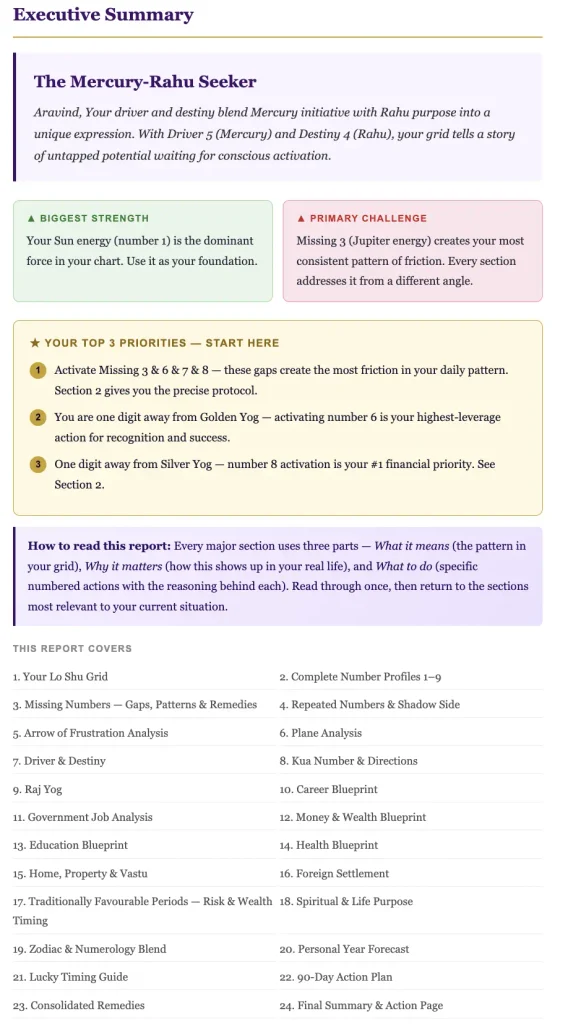
These four pages are from a real report, generated for the date 14 May 1992. Click any of them to read it full size

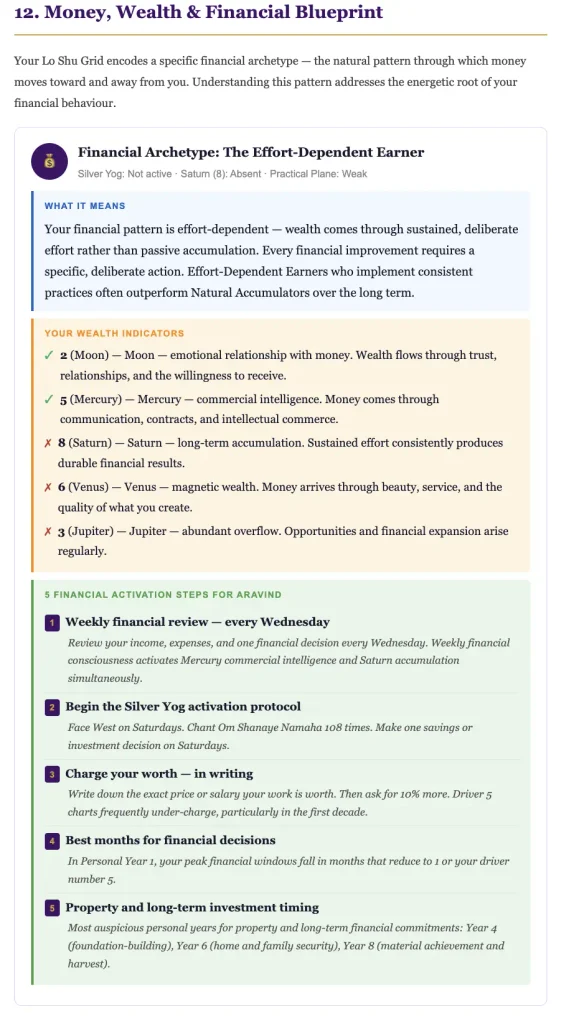
And these are the remedies and action plans in full, exactly as it comes out, nothing trimmed:

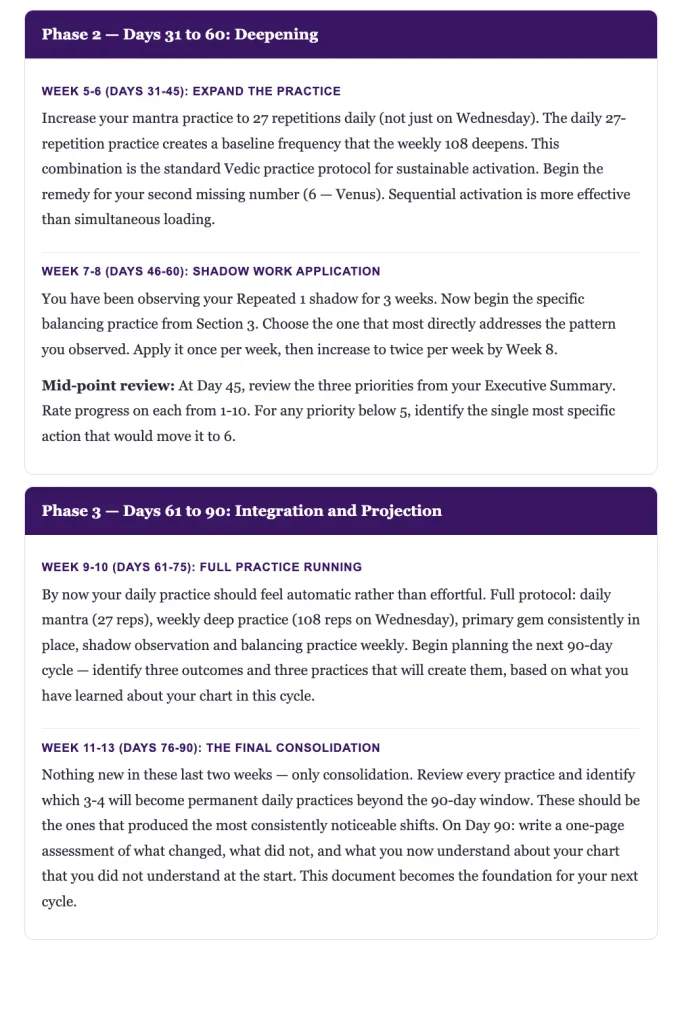

Sample generated for 14 May 1992 on the Personal plan. Your report is built from your own date of birth, so the numbers, the missing cells and every assessment in it will be different.
The full report runs to 41 sections. It is a PDF, it is generated the moment payment clears, and it arrives by email within a few minutes. There is nothing to install and no account to make.
Your 2027 Forecast
Every year hands your chart a few digits it did not have. 2027 is written 2, 0, 2, 7 — the zero drops out, which leaves a 2, a second 2 and a 7.
That matters more than it sounds, because for most people those cells are empty. We checked it against 9,206 real birth dates run through this calculator: 56.1% of readers have no 7 anywhere in their chart, and 27.5% have no 2. For twelve months, those cells fill.
The line most likely to close is the Success Plane, 2 – 7 – 6, which runs down the right-hand column. Two of its three cells are exactly what the year lends. 30.6% of real charts are in the position where that line completes in 2027 — close to one reader in three.
One thing we would rather say now than let you discover in January 2028: a borrowed digit is not the same as owning one. The tradition reads a year number as a condition you are standing in, not a change to the chart. On 1 January 2028 the 7 goes back.
Lo Shu Year Wise Grid Calculator
Each year of your life carries a Personal Year Number derived from your birth date — cycling through 1 to 9 with a distinct theme, energy, and opportunities. The Lo Shu Grid Year Wise Calculator reveals your current year's theme, its specific cautions, and a 5-year forward forecast for career, love, health, and finance.
Each year from now carries a specific numerological theme. Your year-wise forecast maps the energy of each coming cycle.
Frequently Asked Questions
What is a Lo Shu Grid?
A Lo Shu Grid is a 3×3 magic square from Chinese numerology in which numbers 1 to 9 occupy fixed cells and every row, column and diagonal sums to 15. Your birth date fills some cells and leaves others empty, and that pattern of presence, absence and repetition is read as your personal chart.
How is the Driver number calculated?
The Driver number is the day of your birth reduced to a single digit. Born on the 29th: 2+9 = 11, then 1+1 = 2, so the Driver is 2. It represents your instinctive operating energy and is the most immediately recognisable number in a reading.
How is the Destiny number calculated?
The Destiny number is every digit of your full date of birth added together and reduced to a single digit. For 08/05/1984: 0+8+0+5+1+9+8+4 = 35, then 3+5 = 8. Where the Driver describes how you act, the Destiny describes the direction you are acting in.
What do missing numbers mean in the Lo Shu Grid?
Missing numbers are digits from 1 to 9 that appear nowhere in your date digits, Driver or Destiny. They mark qualities that do not activate instinctively and need deliberate development, each with its own planetary ruler and set of traditional remedies. Read the missing numbers guide for all nine patterns.
What is Golden Yog (Raj Yog) in the Lo Shu Grid?
Golden Yog (also called Raj Yog) forms when 4, 5 and 6 are all present, completing the diagonal that runs from the top-left corner of the grid to the bottom-right. It is traditionally associated with recognition, leadership and material success. Under the method this calculator uses your date digits plus your Driver and Destiny. It appears in about 7.85% of birth dates, roughly one in thirteen, based on every calendar date from 1950 to 2010. The widely quoted 2–3% figure applies only to grids built from date digits alone, where Golden Yog appears in 1.89%. Your free result shows whether your chart has it.
How many planes does the Lo Shu Grid have?
The grid has eight lines: six planes and two Yogs. The six planes are the three rows (Mind, Emotional, Practical) and the three columns (Planning, Willpower, Success); the two Yogs are the diagonals, Golden (4-5-6) and Silver (2-5-8). Readings that describe only six lines omit the two diagonals.
Is the Lo Shu Grid different from Western numerology?
Yes. Western systems — Pythagorean and Chaldean — assign values to the letters of a name and reduce them to single numbers. The Lo Shu Grid works from birth-date digits and reads their arrangement across a fixed 3×3 square, examining which cells are filled and which of the eight lines are complete. The two systems answer different questions and are not interchangeable.
Can the Lo Shu Grid predict my future?
No. The grid does not predict events, dates or outcomes. What it maps are patterns — recurring behavioural tendencies, the timing themes of your personal year cycle, and the structural gaps that explain challenges that keep repeating. It describes terrain, not destination.
How accurate is this Lo Shu Grid calculator?
The calculation is exact. Your grid is built by fixed rules from your date of birth, so the same date always produces the same grid, and every number in it can be checked by hand using our published method. The interpretation is a different matter: it follows the traditional Indian Lo Shu reading and is offered for self-reflection. It cannot predict specific events, and it is not a substitute for medical, financial or legal advice.
Interpretations are written and reviewed by Aravind Krishnan, who has studied the system since 2010. Accuracy of the arithmetic is verifiable; accuracy of interpretation is a matter of the tradition being applied, which is why we publish the method rather than asking readers to take it on trust.
How do you make a Lo Shu Grid manually?
Draw a 3×3 grid and fix the positions as 4-9-2 on the top row, 3-5-7 in the middle, 8-1-6 along the bottom. Write out every digit of your date of birth, drop the zeros, add your Driver and Destiny numbers, then place each digit in its matching cell, stacking repeats. The empty cells are your missing numbers.
How should a beginner learn the Lo Shu Grid?
Work in this order: the grid structure and fixed positions, then what each number means individually, then the eight lines and how they form, then missing numbers and their remedies, then practise on charts of people you know well. Generate your own grid with the calculator above first and use it as your first case study — the Learn Lo Shu Grid section is arranged in that sequence.
How to learn Lo Shu Grid?
To learn Loshu Grid, you need to do the following:
- Understand the grid structure and number placements
- Learn what each number means individually
- Study the eight lines: six planes and two Yogs, and how they form
- Study missing numbers and their remedies
- Practise reading grids for people you know.
You can check our Learn Lo Shu Grid section to learn Lo Shu Grid.
What is the Lo Shu Grid used for?
The Lo Shu Grid is used for personality analysis, career alignment, relationship compatibility, financial pattern identification, and personal year timing.
Practitioners use it to identify recurring behavioural patterns that are difficult to see from the inside, pinpoint specific energy gaps that explain persistent life challenges, and prescribe targeted remedies — gemstone, colour, mantra, direction, and lifestyle adjustments — to balance those gaps. It is also widely used for name correction, mobile number selection, business name analysis, and childbirth timing.
What does the Lo Shu Grid represent?
The Lo Shu Grid represents the complete energetic architecture of a person derived from their birth date. The nine cells of the grid correspond to nine planetary energies, nine life domains, and nine behavioural frequencies. Together they map how you think (Mind Plane), how you feel (Emotional Plane), how you act (Practical Plane), your willpower, your planning capacity, and your ability to convert effort into results.
What exactly do I get in the paid report?
A PDF built from your date of birth. It contains your full grid, every present and missing number with its reading, your Driver, Destiny and Kua numbers, which of the eight lines are complete and which are not, your auspicious directions, the remedies the tradition gives for your specific gaps, and a 90-day action plan. The four pages shown earlier on this page are from a real one.
How soon does it arrive?
It is generated the moment payment clears and emailed within a few minutes. You do not need an account and there is nothing to install. If it has not reached you in fifteen minutes, check your spam folder first — it arrives as an attachment, which some mail providers hold back.
What if it doesn’t arrive?
Write to support@loshugridcalculators.com within 24 hours and we refund the full amount. No form, no questions, no partial refund. We reply within 24 to 48 hours, Monday to Saturday.
Can I get a report for someone else?
Yes. Enter their date of birth instead of yours — the report is built from the date, not from who paid.
Is my birth date shared?
No, we don’t share your birthdate data with anyone. It is used only for calulcating your Grid and report.
Which plan should I pick?
Basic at ₹69 if you want your own chart read properly and nothing else — it covers the grid, the missing numbers and the planes. Personal adds the domain blueprints and the 90-day plan. Relationship compares two charts, so it needs two birth dates. Business reads a chart against work and money specifically. The Bundle is everything, and it is cheaper than buying two separately. If you are unsure, Basic is the one to start with; nothing stops you buying a fuller one later.
Can a Lo Shu Grid be completely full?

Almost never. We checked every date from 1900 to 2030 — 47,847 of them — and found six. All six fall on the 26th: 26 July 1934, 26 April 1937, 26 July 1943, 26 March 1947, 26 April 1973 and 26 March 1974.
If a calculator tells you your grid is complete and your date is not one of those six, it is building the grid differently from the way it is describing. That is worth knowing before you act on the reading.