
By Aravind Krishnan · Lo Shu Grid practitioner since 2010 · Last reviewed August 2026
A missing Number 5 leaves the centre of the grid empty, which is the single largest structural gap a chart can carry. This article covers what the absence changes, its effects on decision-making, stability and routine, the traditional remedies, and how it interacts with the rest of your chart.
What Does a Missing Number 5 Mean in the Lo Shu Grid?
A missing Number 5 means the centre cell of your grid is empty — the digit 5 appears in none of your date digits, your Driver, or your Destiny. Number 5 is the Mercury position, carrying the Earth element and holding the centre of the square, and it sits on four of the grid’s eight lines: more than any other digit.
Which lines lose a cell when Number 5 is missing?
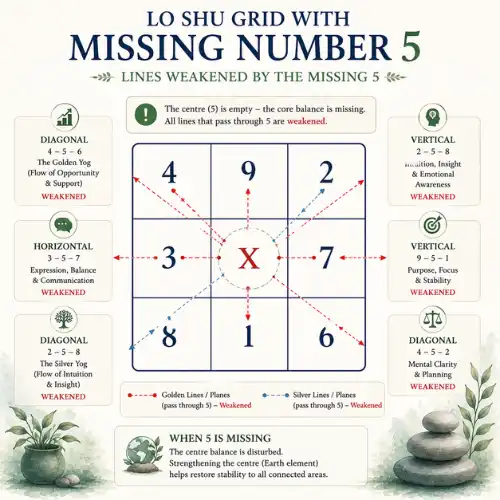
Four lines lose a cell — double what most missing numbers affect. The Emotional Plane (3-5-7) across the middle row, the Willpower Plane (9-5-1) down the centre column, the Golden Yog (4-5-6) on the rising diagonal, and the Silver Yog (2-5-8) on the falling diagonal all drop a strength tier at once.
| Line | Numbers | What the missing 5 removes |
|---|---|---|
| Emotional Plane | 3 · 5 · 7 | The bridge between expression (3) and analysis (7) |
| Willpower Plane | 9 · 5 · 1 | The bridge between ambition (9) and identity (1) |
| Golden Yog | 4 · 5 · 6 | Closes the recognition diagonal permanently |
| Silver Yog | 2 · 5 · 8 | Closes the wealth diagonal permanently |
By Aravind Krishnan · Lo Shu Grid practitioner since 2010 · Last reviewed August 2026
A missing Number 5 leaves the centre of the grid empty, which is the single largest structural gap a chart can carry. This article covers what the absence changes, its effects on decision-making, stability and routine, the traditional remedies, and how it interacts with the rest of your chart.
What Does a Missing Number 5 Mean in the Lo Shu Grid?
A missing Number 5 means the centre cell of your grid is empty — the digit 5 appears in none of your date digits, your Driver, or your Destiny. Number 5 is the Mercury position, carrying the Earth element and holding the centre of the square, and it sits on four of the grid’s eight lines: more than any other digit.
Which lines lose a cell when Number 5 is missing?
Four lines lose a cell — double what most missing numbers affect. The Emotional Plane (3-5-7) across the middle row, the Willpower Plane (9-5-1) down the centre column, the Golden Yog (4-5-6) on the rising diagonal, and the Silver Yog (2-5-8) on the falling diagonal all drop a strength tier at once.
| Line | Numbers | What the missing 5 removes |
|---|---|---|
| Emotional Plane | 3 · 5 · 7 | The bridge between expression (3) and analysis (7) |
| Willpower Plane | 9 · 5 · 1 | The bridge between ambition (9) and identity (1) |
| Golden Yog | 4 · 5 · 6 | Closes the recognition diagonal permanently |
| Silver Yog | 2 · 5 · 8 | Closes the wealth diagonal permanently |
The last two rows are the structurally significant ones. Both diagonals pass through the centre, so a missing 5 is the only single absence in the grid that closes both rare formations at the same time. A missing 4 or 6 closes the Golden Yog; a missing 2 or 8 closes the Silver Yog; a missing 5 closes both. Read the full set in the eight lines of the Lo Shu Grid.
How common is a missing Number 5?
Less common than it appears from looking at a written date, because the Driver and the Destiny both count toward filling the cell. The Destiny calculation reduces the entire date to a single digit and lands on 5 for a substantial share of dates, so many people who see no 5 in their date of birth still have a filled centre. The only reliable check is a full calculation.
What Are the Effects of a Missing Number 5?
Effects on decision-making
The characteristic pattern is oscillation rather than indecision. Without the centre to weigh the Willpower Plane against the Emotional Plane, decisions tend to swing between cold logic and sudden emotional reactivity — two modes rather than a steady middle position between them. People with a missing 5 often describe deciding firmly in one register and then reversing in the other.
Effects on stability and direction
Because both diagonals and the centre column pass through the empty cell, the practical effect is a career and life direction that changes more often than the person would choose. The traditional image is architectural: a building without a central pillar does not collapse, it leans. What is missing is not capability but the anchor that keeps a direction held long enough to compound.
Effects on routine and grounding
Routine tends to be experienced as a cage rather than a foundation. This is the empty centre’s most practical consequence, and it is self-reinforcing: the structure that would supply stability feels restrictive precisely to the person whose grid does not already contain it, which makes it the hardest remedy to adopt and the most useful one to adopt.
Borrowed stability
Many people with a missing 5 instinctively seek a partner, close friend or colleague with a strong 5 to supply the centring their own grid does not. This is a logical compensation rather than a weakness, and it works — with one caveat worth naming in any reading: stability sourced externally moves when the relationship does. Both grids are compared directly in the Lo Shu Grid marriage compatibility calculator.
What Are the Remedies for a Missing Number 5?
Traditional remedies for a missing Number 5 work through Mercury and the Earth element. They are practices rather than guarantees — the tradition treats them as ways of keeping the quality in daily attention, not as mechanisms that produce outcomes.
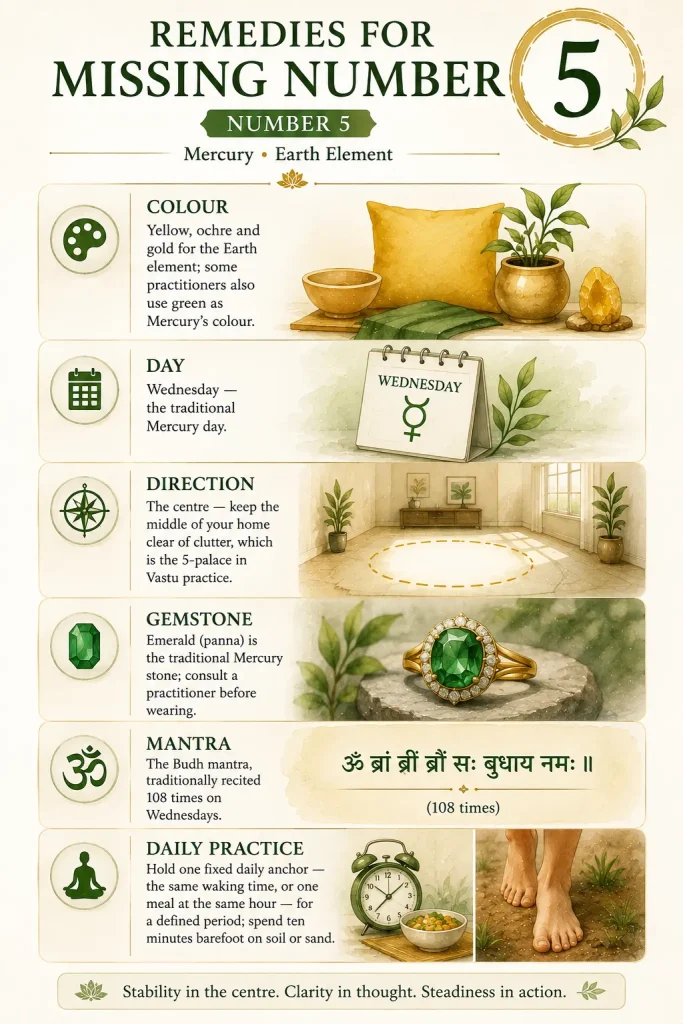
| Remedy type | For Number 5 (Mercury, Earth element) |
|---|---|
| Colour | Yellow, ochre and gold for the Earth element; some practitioners also use green as Mercury’s own colour |
| Day | Wednesday — the traditional Mercury day |
| Direction | The centre — keep the middle of your home clear of clutter, which is the 5-palace in Vastu practice |
| Gemstone | Emerald (panna) is the traditional Mercury stone; consult a practitioner before wearing |
| Mantra | The Budh mantra, traditionally recited 108 times on Wednesdays |
| Daily practice | Hold one fixed daily anchor — the same waking time, or one meal at the same hour — for a defined period; spend ten minutes barefoot on soil or sand |
The fixed daily anchor is the remedy practitioners emphasise for this gap specifically. An empty centre describes stability that is not inherited, and a single unvarying point in the day builds it by repetition — which is the only mechanism available when the structural version is absent. Starting with one anchor rather than a full routine matters, because a full routine is exactly what a missing 5 finds intolerable.
How a Missing Number 5 Interacts With the Rest of Your Grid
With Numbers 3 and 7 present. The Emotional Plane holds two of three cells: expression and analysis are both available with nothing joining them. This is the clearest version of the oscillation pattern — the capacity to feel and the capacity to reason are intact, and they operate alternately rather than together.
With Numbers 9 and 1 present. The Willpower Plane holds ambition and identity without the bridge. The traditional reading is drive that starts strongly and dissipates before completion, and it is the most commonly reported experience of this gap. See Number 9 in the Lo Shu Grid.
With Number 9 also missing. The Willpower Plane is left holding only the 1 — the weakest that line can be short of an Arrow of Frustration, which is the term for any of the eight lines with all three cells empty.
With Numbers 4 and 6, or 2 and 8, present. One diagonal sits two-thirds filled and permanently closed. Worth stating plainly in a reading, because near-completion is routinely misread as nearly achieved — see Golden Yog in the grid and Silver Yog in the grid.
What Number 5 does when present. For the full profile of the energy this cell holds, read Number 5 in the Lo Shu Grid. Every absence pattern is indexed in the Lo Shu Grid missing numbers guide.
To confirm whether your own centre is genuinely empty — remembering that the Driver and Destiny both count — run your date through the Lo Shu Grid calculator.
Frequently Asked Questions About Missing Number 5
Is a missing Number 5 the worst missing number?
It is the largest structural gap, because 5 sits on four lines and no other digit sits on more than three. That makes it the widest-reaching absence, not a worse fate — the tradition reads it as stability that must be built deliberately rather than inherited.
Can I have Golden Yog or Silver Yog with a missing 5?
No. Both diagonals pass through the centre cell, so a missing 5 closes both permanently. It is the only single absence in the grid that blocks two formations at once.
How do I know if Number 5 is really missing from my grid?
Check three places: every digit of your date of birth, your Driver number, and your Destiny number. A 5 in any one of them fills the cell. The Destiny reduction lands on 5 often enough that many dates without a visible 5 still have a filled centre.
What is the best remedy for a missing Number 5?
One fixed daily anchor — the same waking time, or one meal at a set hour — held for a defined period. Practitioners start with a single anchor rather than a full routine, because a full routine is what a missing 5 finds hardest to sustain.